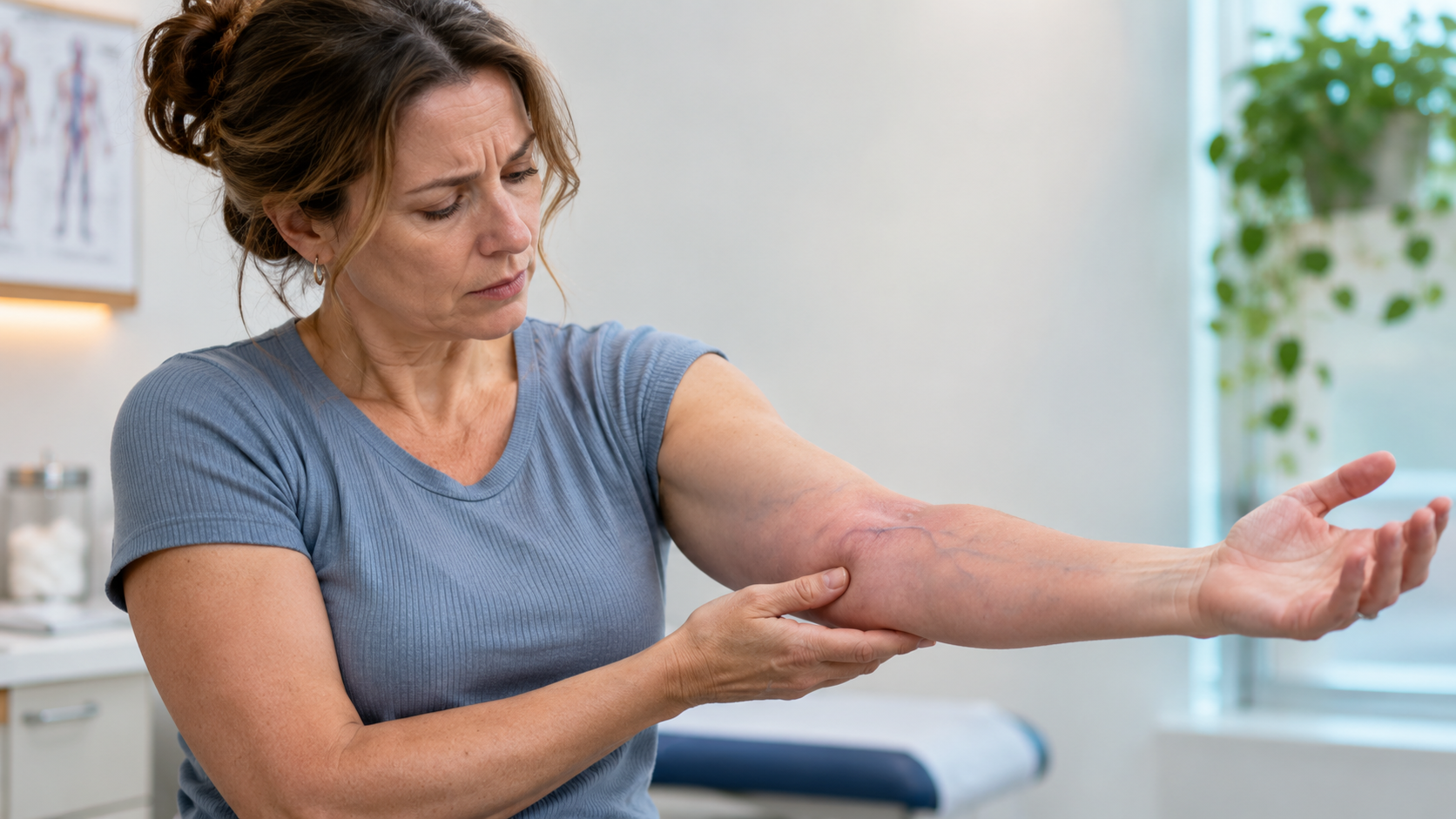

Have you ever noticed that one of your arms looks a little bigger than the other? Perhaps your sleeve feels tighter, your watch suddenly seems uncomfortable, or your arm feels unusually heavy by the end of the day.
Or maybe you’ve noticed something more subtle — veins becoming more prominent, an aching sensation after exercise, or a change in the shape of your upper arms that you simply can’t explain.
When patients come to see me with these concerns, one of the first things I tell them is this:
Not all arm swelling is caused by the same problem, and not every swollen arm means there is something seriously wrong. But unexplained swelling is something we should always take seriously.
There are several possible reasons for swelling or enlargement of the arms. Some involve the veins, others involve the lymphatic system, and certain conditions, such as lipoedema, affect the fatty tissue beneath the skin.
The important thing is understanding what is causing your symptoms, rather than simply trying to make the swelling go away.
First, Let’s Understand Why Arms Become Swollen
Your arms rely on two important drainage systems.
The first is your venous system. Your veins carry blood from your hands and arms back towards your heart.
The second is your lymphatic system, a network of tiny vessels that helps remove excess fluid from your tissues and supports your immune system.
If either system isn’t working properly, fluid can accumulate, causing swelling, tightness or heaviness.
However, there is another important distinction: sometimes an arm appears enlarged not because of excess fluid, but because of changes in the fatty tissue itself. This is where conditions such as lipoedema come into the picture.
As a vascular specialist, I look closely at these differences because they help us decide which investigations are necessary and what treatment is likely to help.
1. Could It Be a Problem With Your Veins?
One of the conditions we need to exclude when someone develops sudden swelling in one arm is an upper limb deep vein thrombosis, commonly called an arm DVT.
A DVT occurs when a blood clot forms in one of the deeper veins, restricting the normal return of blood to the heart.
You might notice that your arm has become swollen over a relatively short period. It may feel tight, heavy or uncomfortable. Sometimes the skin looks reddish or bluish, and the veins across your shoulder or upper chest become more visible.
What surprises many patients is that a blood clot in the arm doesn’t always cause severe pain.
Some people describe little more than an uncomfortable feeling of fullness or an arm that suddenly seems larger than normal.
There are several reasons an arm DVT might develop. These include clotting disorders, cancer, intravenous catheters, pacemaker leads and, occasionally, strenuous or repetitive upper-body activity.
If you develop sudden unexplained swelling in one arm, particularly with pain or discolouration, it is important to seek urgent medical assessment on the same day. A blood clot needs to be identified and treated promptly.
2. What If My Arm Swells After Exercise or Overhead Activity?
This is an interesting pattern that can sometimes point us towards a condition called venous thoracic outlet syndrome.
Let me explain it simply.
There is a relatively narrow space between your collarbone and first rib through which important blood vessels travel.
In some people, the main vein draining blood from the arm becomes compressed in this space, especially during certain movements.
Imagine gently squeezing a garden hose. Water may still pass through, but the flow becomes restricted.
Something similar can happen when a vein is compressed.
You may notice your arm feels heavy or swollen after swimming, weight training, repetitive lifting or working with your arms above your head.
Some patients notice prominent veins around their shoulders or chest. Others experience bluish discolouration or an uncomfortable feeling of pressure.
This condition can affect young, otherwise healthy and active people.
Occasionally, persistent compression contributes to the formation of a clot, a condition known as Paget–Schroetter syndrome, or effort thrombosis.
Not everyone with these symptoms has thoracic outlet syndrome, but recognising the pattern can help guide further investigation.
3. Could It Be Lymphoedema?
Another important cause of arm swelling is lymphoedema.
This occurs when the lymphatic system cannot drain fluid from the tissues as efficiently as it should.
I often explain to patients that the lymphatic system works like a drainage network. If part of that network becomes damaged, blocked or underdeveloped, fluid can gradually build up.
Lymphoedema may develop after surgery, particularly when lymph nodes have been removed, or following radiotherapy.
For this reason, we sometimes see it in people who have undergone treatment for breast cancer or other cancers.
However, lymphoedema can also occur without any previous surgery or cancer treatment.
You might notice:
Swelling involving your arm, hand or fingers
Rings or watches becoming tighter
A persistent feeling of heaviness
Difficulty fitting into sleeves
Skin that gradually becomes firmer or thicker
Swelling that initially improves overnight but returns during the day
One of the challenges with lymphoedema is that it may begin very subtly.
Patients sometimes tell me, “I noticed my arm felt different months before I could actually see the swelling.”
That is why recognising the early symptoms matters. Although lymphoedema is generally a long-term condition, appropriate management can significantly improve comfort, function and quality of life.
4. What About Lipoedema? An Often Overlooked Cause of Enlarged Arms
Lipoedema is a condition I particularly want patients to understand, because it is frequently misunderstood.
Unlike venous swelling or lymphoedema, lipoedema primarily involves an abnormal accumulation of fatty tissue, rather than simply fluid collecting in the arm.
It most commonly affects the hips, thighs and legs, but it can also involve the upper arms.
Lipoedema occurs predominantly in women and may become noticeable or worsen during periods of hormonal change, such as puberty, pregnancy or menopause.
A typical patient might say to me:
“My upper arms have always seemed disproportionately large compared with the rest of my body. They feel tender, bruise easily, and no matter how much weight I lose, their shape doesn’t seem to change very much.”
That history can be an important clue.
Unlike a sudden venous obstruction, lipoedema generally develops gradually and tends to affect both sides of the body in a fairly symmetrical pattern.
Patients may experience tenderness, aching, heaviness, easy bruising and changes in the texture of the fatty tissue beneath the skin.
Another useful distinction is that the hands are usually spared, even when the upper arms are noticeably enlarged.
Is lipoedema the same as being overweight?
No, and this is an important conversation to have.
Lipoedema is a recognised chronic condition affecting fatty tissue. While body weight can influence symptoms and additional weight gain may make the condition harder to manage, lipoedema is not simply the result of overeating or being inactive.
Patients often feel frustrated because they have tried dieting and exercise without seeing the changes they expected in their affected limbs.
It is important that these concerns are listened to and assessed appropriately.
Lipoedema also differs from lymphoedema, although the two conditions can sometimes coexist.
There is currently no definitive cure for lipoedema, but symptoms can often be managed through an individualised approach that may include suitable compression, physical activity, weight management where appropriate, and specialist multidisciplinary care.
One important point: lipoedema would not usually explain sudden swelling in just one arm. If that happens, we still need to investigate for other causes, particularly a venous clot.
5. Are There Other Reasons Why My Arm Might Be Swollen?
Absolutely.
Not every swollen arm is caused by a vascular or lymphatic disorder.
Sometimes, the explanation is relatively straightforward, such as an injury, inflammation, an infection or a reaction to medication.
In other cases, swelling can be associated with conditions affecting the heart, kidneys or liver, particularly when fluid retention involves multiple parts of the body.
Previous blood clots can also leave behind damage or narrowing in the veins, resulting in longer-term swelling.
Occasionally, a vein may be compressed by a structure within the chest or shoulder region, preventing blood from draining normally.
The important message is that arm swelling is a symptom, not a diagnosis.
Simply recognising that your arm is swollen doesn’t tell us why it is happening.
And until we understand the cause, we cannot confidently recommend the most appropriate treatment.
How Can We Tell the Difference?
One of the most useful things you can tell me during a consultation is how your symptoms started.
Did the swelling develop suddenly, or has it been gradually increasing over several years?
Does it affect one arm or both?
Is your hand swollen too, or is the enlargement mainly around your upper arms?
Do your arms feel painful or tender when touched? Do you bruise easily? Have you noticed prominent veins?
These details are particularly helpful because different conditions often follow different patterns.
What you notice | What we may consider |
|---|---|
Sudden swelling in one arm | DVT or venous obstruction |
Swelling after overhead activity | Venous thoracic outlet syndrome |
Persistent swelling involving the hand and fingers | Lymphoedema |
Both upper arms enlarged, tender and easily bruised, with hands relatively unaffected | Lipoedema |
Redness, warmth, pain and fever | Infection or inflammation |
Swelling in both arms and other parts of the body | Medication effects or systemic fluid retention |
These are clues, not diagnostic rules. Conditions can overlap, and a patient may have more than one contributing problem.
For example, someone with lipoedema may also develop lymphoedema or venous disease. Finding one condition does not automatically exclude another.
What Happens When You See a Vascular Specialist?
I understand that discovering unexplained swelling can be worrying, particularly when you have already searched online and come across conditions such as blood clots or blocked veins.
My approach is to understand your symptoms properly before deciding which investigations you need.
We’ll discuss when the problem started, how it affects your daily activities, and any relevant medical history. I’ll examine both arms, looking at their shape, skin, veins, tissue consistency and distribution of swelling.
If I suspect a venous problem, a duplex ultrasound is often the first investigation. This painless, non-invasive scan allows us to examine blood flow and look for blood clots.
If there is concern about narrowing or compression of the larger veins near the shoulder or chest, CT or MR venography may be useful.
When lymphoedema is suspected, further assessment of lymphatic function may sometimes be appropriate.
Lipoedema, on the other hand, is primarily diagnosed through your medical history and clinical examination. Imaging may be helpful in selected cases to investigate other conditions, but there is no single scan that confirms lipoedema in every patient.
The goal is to avoid unnecessary investigations while making sure we don’t overlook an important diagnosis.
Can Arm Swelling Be Treated?
In many cases, yes. But treatment depends on what is actually causing the problem.
A blood clot may require anticoagulant medication and, in selected circumstances, a procedure to restore blood flow.
Venous thoracic outlet syndrome may require specialist intervention if there is significant compression or clot formation.
Lymphoedema is often managed through an individualised programme involving compression, exercise, skin care and specialist lymphatic therapy.
For lipoedema, management generally focuses on reducing discomfort, supporting mobility and addressing associated conditions. Carefully selected compression, exercise and multidisciplinary care may be helpful. In certain patients, specialist surgical options may also be considered after detailed assessment.
What works for one condition may not be appropriate for another.
This is why I would not recommend starting compression garments or intensive massage for a newly swollen arm before the underlying cause has been assessed, particularly if a blood clot is possible.
When Should You Be Concerned?
I often tell patients that you don’t need to panic every time you notice a change in your arm, but you should pay attention to what your body is telling you.
If your arm has become swollen for no obvious reason, arrange prompt medical assessment. Sudden swelling, significant pain, colour changes or warmth require urgent same-day assessment.
If you develop shortness of breath, chest pain, fainting or coughing up blood, call 000 immediately. These can be symptoms of a pulmonary embolism, a potentially life-threatening complication of a blood clot.
A suddenly cold, pale or severely painful arm, particularly with weakness or loss of sensation, is also a medical emergency.
If your symptoms have developed more gradually — perhaps your upper arms have changed shape, you bruise easily, or your arm has felt heavy for months — it is still worth discussing these changes with your doctor.
You do not need to wait until the swelling becomes severe to seek help.
My Advice: Don’t Ignore the Changes You Notice
If there is one thing I would like you to take away from this article, it is that not all arm swelling is the same, and understanding the cause makes all the difference.
Some patients come to us concerned about a blood clot, only to discover that their symptoms are related to lymphoedema.
Others have spent years feeling self-conscious about disproportionately enlarged, painful upper arms without realising that lipoedema may be contributing to their symptoms.
And occasionally, what seems like a minor change in arm size or visible veins turns out to be an important circulation problem that needs treatment.
Whatever the cause, your symptoms deserve to be taken seriously.
You know your body better than anyone. If something has changed, if one arm feels different, or if swelling is beginning to interfere with your comfort or everyday life, it is worth finding out why.
The earlier we understand the problem, the sooner we can work towards the right treatment and help you feel more comfortable and confident.
Concerned About Unexplained Arm Swelling?
Whether you’re experiencing sudden swelling, prominent veins, persistent heaviness or changes in the shape of your upper arms, an appropriate medical assessment can help identify the cause.
A vascular specialist can investigate possible circulatory problems, distinguish them from lymphatic or fatty-tissue disorders, and guide you towards suitable treatment or specialist care.
You don’t have to keep wondering why your arm is swollen. Getting the right diagnosis is the first step towards finding an answer.
Medical Disclaimer
The information provided in this article is intended for general educational and informational purposes only and should not be considered a substitute for professional medical advice, diagnosis or treatment.
Symptoms such as arm swelling, pain, heaviness or visible veins may have several underlying causes, and an accurate diagnosis requires an individual medical assessment.
If you experience sudden or unexplained swelling in one arm, seek prompt medical attention to exclude potentially serious conditions such as deep vein thrombosis (DVT). If you develop chest pain, sudden shortness of breath, fainting or coughing up blood, call 000 (Australia) immediately.
Always consult your GP or an appropriately qualified healthcare professional regarding any symptoms, medical concerns or treatment decisions.