
Finding a new bulging or twisted vein can be unsettling—especially when you already live with Ehlers-Danlos syndrome.
You may wonder whether the vein is another symptom of EDS, whether it could be dangerous or whether standard varicose-vein treatment is safe for you.
The honest answer is that the situation is different for every person.
Varicose veins are common in the general population and do not automatically indicate a serious connective-tissue problem. However, varicose veins that develop unusually early are also a recognised feature of vascular Ehlers-Danlos syndrome, commonly known as vEDS.
That does not mean everyone with varicose veins has vEDS. It means that the age at which the veins appeared, your EDS subtype, your family history and any accompanying symptoms all deserve consideration.
What are varicose veins?
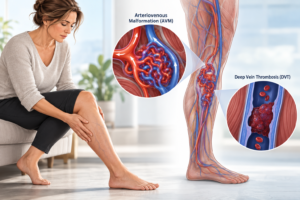
Varicose veins are enlarged or twisted veins that usually appear in the legs. They develop when valves inside the veins do not move blood towards the heart as effectively as they should.
When these valves allow blood to flow backwards, pressure can build inside the vein. Over time, the vein may widen and become raised or visibly twisted.
Varicose veins can appear blue, purple or close to the surrounding skin tone. Colour changes may be less noticeable on darker skin, so swelling, shape, tenderness and changes in the surrounding skin can also be important.
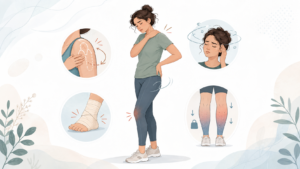
Common symptoms include:
- aching, burning or throbbing legs;
- a heavy or tired feeling in the legs;
- ankle or lower-leg swelling;
- itching around the affected veins;
- muscle cramps;
- discomfort after sitting or standing for long periods;
- dry, irritated or discoloured skin;
- bleeding or sores around the ankle in more advanced cases.
Some people have visible varicose veins without pain or other symptoms.
Can Ehlers-Danlos syndrome cause varicose veins?
EDS describes a group of inherited connective-tissue disorders. Connective tissue supports many parts of the body, including the skin, joints and blood vessels.
It is therefore understandable to assume that any visible or enlarged vein must be caused by EDS. The connection is more complicated than that.
Varicose veins can occur in people with or without EDS. They can also affect people with different EDS subtypes. However, the strongest recognised connection is between early-onset varicose veins and vascular EDS.
The Ehlers-Danlos Society describes varicose veins appearing before age 30—and before pregnancy in women—as a possible feature of vEDS.
Ordinary or later-onset varicose veins alone are not enough to suggest that someone has vEDS. GeneReviews specifically notes that nonspecific venous findings, such as varicose veins, should not be treated as proof of the condition.
Why is vascular EDS different?
Vascular EDS is a rare form of Ehlers-Danlos syndrome that mainly affects the arteries, certain internal organs and other connective tissues.
It is most often associated with a disease-causing variant in the COL3A1 gene, which is involved in producing type III collagen. This form of collagen contributes to the structure of blood vessels, skin and hollow organs.
Because the tissues and blood vessels of someone with vEDS may be unusually fragile, invasive procedures require careful planning. This does not mean that every person with vEDS will experience the same complications. It does mean that clinicians need to consider the diagnosis before recommending treatment.
A diagnosis of vEDS is confirmed through appropriate genetic testing rather than through varicose veins or physical appearance alone.
Visible veins are not always varicose veins
Many people with EDS have thin or translucent skin, which can make otherwise normal veins more noticeable.
A vein that can easily be seen through the skin is not necessarily damaged or enlarged. The Ehlers-Danlos Society notes that translucent skin can make deeper veins more visible and that translucent skin can also occur in people who do not have EDS.
Spider veins are also different from larger varicose veins. Spider veins are small vessels close to the skin’s surface. They often form thin red, blue or purple lines, while varicose veins tend to be larger, raised and twisted.
A clinical examination and, when necessary, an ultrasound can determine whether a visible vein is simply noticeable or whether it is affected by venous reflux.
When should you see a doctor?
You should arrange a medical assessment when a varicose vein is causing:
- persistent pain, aching or heaviness;
- swelling in the ankle or lower leg;
- itching, eczema or skin irritation;
- darkening or hardening of the surrounding skin;
- repeated inflammation;
- bleeding;
- a wound or sore that is slow to heal;
- a rapid or unexplained change in appearance.
You should also discuss early-onset varicose veins with your doctor when you have not been diagnosed with an EDS subtype, particularly if you have a personal or family history of serious vascular complications.
Seek urgent medical care for:
- sudden swelling or significant pain in one leg;
- a vein that becomes hard, hot, red or very tender;
- bleeding that does not stop after firm pressure;
- sudden shortness of breath;
- chest pain;
- fainting;
- coughing up blood;
- sudden, severe or unexplained pain.
People with confirmed vEDS should follow the emergency guidance provided by their specialist team. New severe symptoms should not automatically be dismissed as ordinary EDS symptoms.
Could early varicose veins indicate vascular EDS?
Early varicose veins can be one clue, but they do not confirm vEDS.
A doctor may consider further investigation when early-onset veins occur alongside features such as:
- unusually easy or extensive bruising;
- thin, translucent skin;
- a family history of confirmed vEDS;
- unexplained arterial rupture or dissection;
- a history of certain organ ruptures;
- spontaneous pneumothorax;
- tendon or muscle rupture;
- clubfoot present at birth;
- unexplained sudden death in a close relative.
Clinical context is essential. Many people develop varicose veins at a young age without having vascular EDS.
A genetics professional or clinician experienced in heritable connective-tissue disorders can decide whether genetic testing is appropriate.
How are varicose veins diagnosed in someone with EDS?
The assessment generally begins with a medical history and physical examination.
Your doctor may ask:
- when the veins first appeared;
- whether they developed before or after pregnancy;
- whether you experience pain, itching or swelling;
- whether you have had a blood clot;
- which EDS subtype you have;
- whether you bruise easily or heal slowly;
- whether your skin reacts to dressings or adhesives;
- whether you have experienced complications during previous procedures;
- whether vascular problems run in your family.
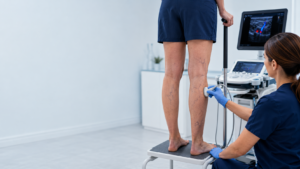
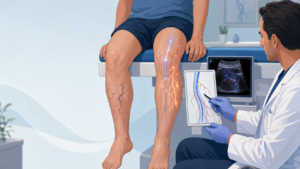
A doctor may recommend a duplex ultrasound. This non-invasive scan checks the direction of blood flow and identifies veins with poorly functioning valves. It is commonly used to confirm varicose veins and plan treatment.
An ultrasound assesses how your veins are working. It does not diagnose EDS or determine your EDS subtype.
How are varicose veins treated when you have EDS?
Treatment depends on your symptoms, ultrasound findings, general health and EDS subtype.
The right approach for one person may not be appropriate for another. This is particularly important when vEDS is confirmed or suspected.
Regular movement
Walking and gentle movement help activate the calf muscles, which support the movement of blood out of the legs.
Try to break up long periods of sitting or standing. Moving your ankles, taking short walks and elevating your legs may help reduce swelling or heaviness.
Exercise should be adapted to your joint stability, pain levels and cardiovascular history. People with vEDS are generally advised to avoid collision sports, extreme straining and very heavy lifting.
Compression garments
Properly fitted compression stockings can help reduce aching and swelling. They apply controlled pressure to the legs and support venous blood flow.
Compression is not suitable for everyone, particularly when arterial circulation is reduced. The type and strength should therefore be recommended by a qualified healthcare professional.
EDS can also make compression garments challenging to use. Fragile skin, hand pain, finger instability and sensory sensitivity may make tight stockings difficult to put on.
Possible solutions include:
- application aids;
- gloves designed for compression garments;
- open-toe stockings;
- alternative compression wraps;
- assistance from another person;
- a different compression level or material.
Do not continue wearing a garment that causes severe pain, numbness, skin damage or significant colour changes.
Skin care
Dry or irritated skin around varicose veins can become fragile and uncomfortable.
Use a gentle moisturiser, avoid scratching and seek medical advice about eczema, inflammation or broken skin. Tell your medical team about fragile skin and adhesive reactions before dressings or compression bandages are applied.
Medical procedures
Treatments used for varicose veins in the general population can include:
- endovenous thermal ablation;
- foam sclerotherapy;
- other methods that close the affected vein;
- surgical removal;
- compression therapy.
A duplex ultrasound is normally used to determine which veins are affected and which treatment may be suitable.
However, confirmed vascular EDS changes the risk assessment.
VASCERN warns that fragile vessels may increase the risk of complications, including venous rupture, and that management should be tailored to the individual. Specialist guidance also advises against conventional vein stripping for saphenous insufficiency in vEDS because of the risk of vascular injury.
This does not mean that no procedure can ever be performed. It means that the decision should involve clinicians familiar with vEDS and should not be treated as a routine cosmetic intervention.
Before agreeing to a procedure, tell the clinician:
- your exact EDS diagnosis;
- whether vEDS is suspected;
- whether you have a COL3A1 variant;
- whether you have fragile skin or poor wound healing;
- whether you bruise or bleed easily;
- whether you have experienced previous procedural complications;
- which specialists manage your EDS.
Questions to ask Before Getting Your Veins Treated?
Consider taking these questions to your appointment:
- Does my ultrasound show venous reflux or another problem?
- Are the visible veins responsible for my symptoms?
- Does my EDS subtype affect the proposed treatment?
- Have you treated patients with vEDS or similar connective-tissue disorders?
- Could conservative treatment be tried first?
- What are the risks of bleeding, skin injury and poor wound healing?
- Should my geneticist or EDS specialist review the treatment plan?
- Which symptoms would require urgent attention after treatment?
- Are there treatments you would avoid because of my diagnosis?
- How will the procedure be adapted to protect fragile tissue?
Varicose veins, EDS and pregnancy
Pregnancy can cause or worsen varicose veins because blood volume increases and pressure on the veins in the pelvis and legs becomes greater.
Compression garments may be recommended for symptom relief, while procedures are often postponed until after pregnancy.
Pregnancy in someone with vascular EDS involves additional medical considerations that extend beyond varicose veins. Anyone with confirmed vEDS who is pregnant or considering pregnancy should receive coordinated advice from an experienced multidisciplinary team.
Frequently asked questions
Are varicose veins common in EDS?
People with any form of EDS can develop varicose veins, just as people without EDS can. Early-onset varicose veins have a specifically recognised association with vascular EDS, but reliable prevalence data covering every EDS subtype remain limited.
Do varicose veins mean I have vascular EDS?
No. Varicose veins are common and cannot diagnose vEDS. Their age of onset and the presence of other personal or family-history features determine whether further investigation should be considered.
Can varicose veins be mistaken for visible veins?
Yes. Thin or translucent skin can make normal veins easier to see. A duplex ultrasound can help determine whether a vein has faulty valves or abnormal blood flow.
Can people with EDS wear compression stockings?
Many people with EDS can wear compression garments, but they should be properly fitted. The person prescribing them should consider circulation, skin fragility, pain, joint instability and sensory sensitivity.
Is laser treatment safe for someone with EDS?
There is no single answer for every subtype or patient. Procedures routinely used in the general population may require extra precautions in someone with EDS. Confirmed vEDS calls for specialist assessment because of blood-vessel and tissue fragility.
Can exercise remove varicose veins?
Exercise will not normally remove an established varicose vein. Gentle movement may, however, improve circulation and reduce aching, swelling or heaviness.
Should varicose veins in EDS be treated?
Treatment is usually considered when veins cause pain, swelling, skin damage, bleeding or other complications. The risks and expected benefits should be assessed individually, particularly when vascular EDS is involved.
The bottom line
Varicose veins in EDS should be approached with balance.
They should not automatically cause alarm, because varicose veins are common and many are manageable. At the same time, early-onset veins or symptomatic veins should not be dismissed—especially when vascular EDS is confirmed or suspected.
The safest approach is to determine:
- whether the vein has abnormal blood flow;
- whether it is causing your symptoms;
- which EDS subtype you have;
- whether conservative treatment may help;
- whether a specialist familiar with connective-tissue disorders should be involved.
With an accurate assessment and an EDS-aware treatment plan, patients can make informed decisions without treating every visible vein as an emergency—or overlooking symptoms that deserve attention.
Medical disclaimer: This article provides general educational information and is not a substitute for personalised medical advice, diagnosis or emergency care. Speak with a qualified healthcare professional who understands your medical history and EDS subtype.