
Pain, Repeated Injuries and Dizziness: Could Hypermobility Be the Missing Connection?
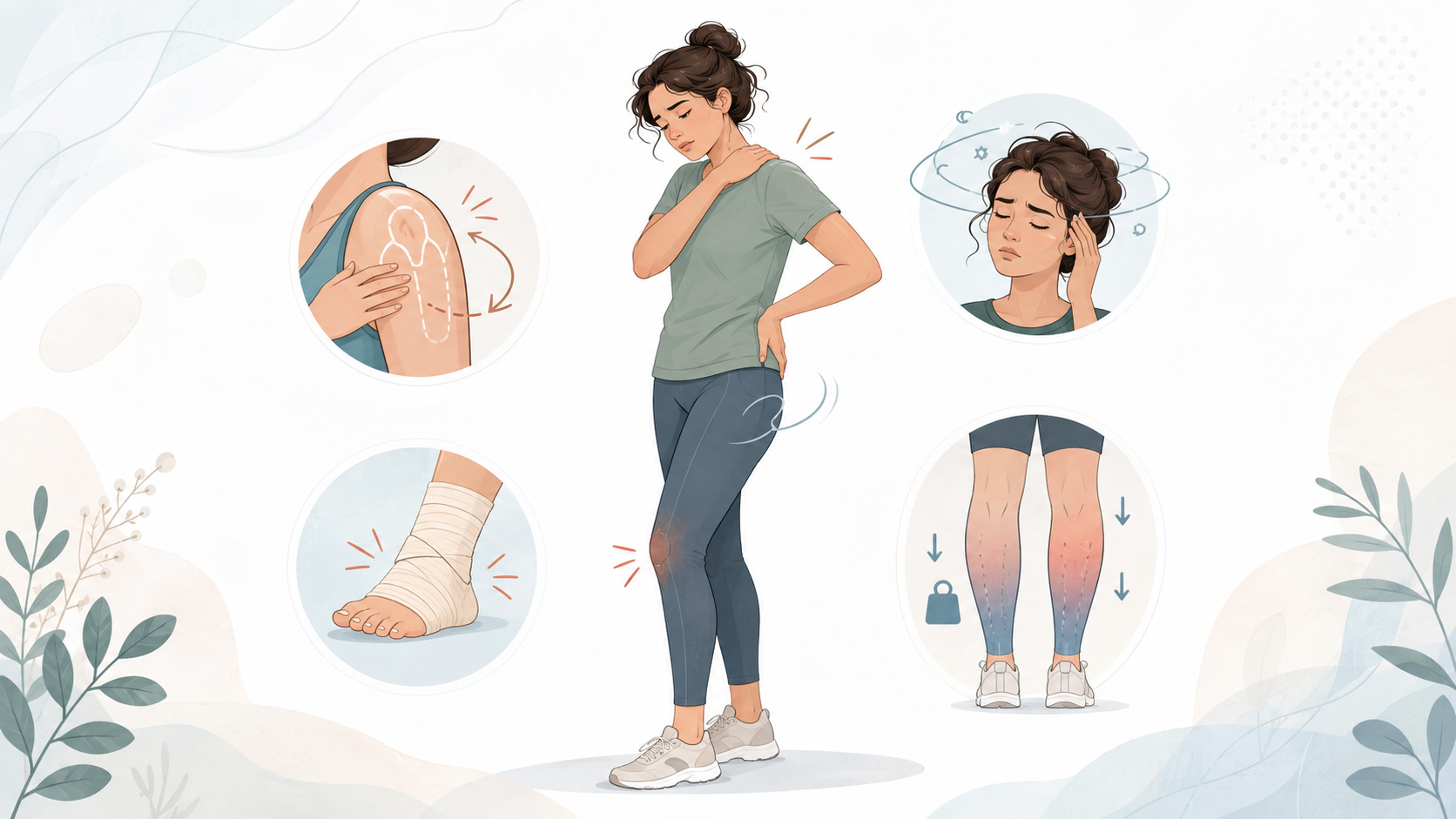
You have seen someone about your back pain.
You have had physiotherapy for an ankle that keeps rolling.
Your shoulder clicks or feels unstable.
You sometimes become dizzy when you stand up, your heart races for no obvious reason, or your legs feel unusually heavy after being on your feet.
Perhaps you also experience fatigue, headaches, digestive problems or other symptoms that seem completely unrelated.
Each problem may have been looked at separately.
But sometimes, the pattern matters more than any single symptom.
For some people, persistent pain, repeated injuries, joint instability and symptoms affecting other parts of the body occur alongside joint hypermobility.
And surprisingly, many people who are hypermobile do not realise it.
What is joint hypermobility?
Joint hypermobility simply means that one or more joints move beyond the range expected for most people.
Some people are naturally flexible and have absolutely no problems because of it.
Others develop symptoms such as pain, repeated injuries or joint instability.
When symptomatic hypermobility is part of a broader clinical picture, a healthcare professional may consider conditions such as hypermobility spectrum disorder (HSD) or hypermobile Ehlers-Danlos syndrome (hEDS).
Importantly, being flexible does not automatically mean you have Ehlers-Danlos syndrome.
And you do not need to be able to do the splits to have a history of hypermobility.
So how might someone reach adulthood without ever realising that hypermobility could be relevant?
Often, they seek medical care for something else first.
Here are three common reasons.
1. “Why do I keep hurting myself?”
For many people, the first clue is not flexibility.
It is pain or repeated injury.
They may have a long history of:
ankle sprains
painful knees
shoulder problems
recurring tendon pain
neck or back pain
joints that click, catch or feel unstable
joints that occasionally feel as though they move out of place
pain after relatively minor activity
injuries that seem to happen more easily than expected
symptoms that keep returning despite treatment
A teenager might simply think, “I’m bad at sport.”
An adult may describe themselves as “injury-prone.”
Someone else may have been told that they have poor posture, weak muscles or recurring tendinitis.
Sometimes these explanations are correct.
But when the same person has problems affecting several joints over many years, it can be useful to ask another question:
Could joint hypermobility be contributing to the problem?
Why can hypermobile joints become painful?
A joint needs more than movement.
It also needs control and stability.
Ligaments, muscles, tendons and other connective tissues help keep a joint moving within a useful range.
If a joint moves more than usual, the muscles around it may need to work harder to control that movement.
Over time, some people can develop muscle fatigue, soft-tissue overload, joint irritation or compensatory movement patterns.
This does not mean every pain in a hypermobile person is caused by hypermobility.
Pain has many possible causes.
But a history of repeated pain + recurrent injury + joint instability is worth looking at as a pattern rather than as a collection of completely separate injuries.
2. “Why do I get dizzy or feel my heart racing when I stand?”
This symptom can seem completely unrelated to painful joints.
You stand up and suddenly feel light-headed.
Your heart starts beating faster.
You may feel shaky, weak, nauseated or mentally foggy.
Standing in a queue can feel surprisingly difficult.
A hot shower might make you feel worse.
Sitting or lying down may make you feel better.
This group of symptoms can sometimes be described as orthostatic intolerance.
“Orthostatic” simply means related to being upright.
What happens when we stand?
When you stand, gravity causes some blood to move towards the lower part of your body.
Your body normally responds quickly.
Blood vessels adjust, the heart adapts and the nervous system helps maintain enough circulation to the brain.
Most of us never notice this happening.
But in some people, that adjustment does not work as smoothly.
They may experience symptoms including dizziness, palpitations, weakness, blurred vision, brain fog, nausea, headache or, occasionally, fainting.
One condition associated with orthostatic intolerance is postural orthostatic tachycardia syndrome, or POTS.
But this distinction is important:
Feeling dizzy when standing does not automatically mean you have POTS.
Orthostatic symptoms can have many causes, including dehydration, medications, anaemia, blood-pressure problems and other medical conditions.
POTS has specific diagnostic criteria and should not be diagnosed from symptoms alone.
What does this have to do with hypermobility?
Research has found that orthostatic intolerance and POTS are reported more often in people with hypermobile Ehlers-Danlos syndrome and hypermobility spectrum disorders.
Exactly why these conditions overlap is still being investigated.
The autonomic nervous system, circulation, blood-volume regulation, vascular responses, physical conditioning and other factors may all contribute.
This is why it is important not to reduce the relationship to a simple explanation such as:
“Your veins are stretchy, so you have POTS.”
The biology is more complicated than that.
For someone who has joint hypermobility, persistent pain and significant symptoms when standing, however, the combination may be worth discussing with a healthcare professional.
3. “Why do my legs feel heavy, swollen or different when I stand?”
This third group of symptoms is particularly important because people may assume it has nothing to do with their other problems.
Their legs might:
feel heavy or achy
become uncomfortable after standing
swell
feel full or tight
show prominent veins
develop red, bluish or purple colour changes while upright
Some people also notice that symptoms improve when they lie down or elevate their legs.
There are several possible explanations for symptoms like these.
One is venous pooling, where more blood collects in the lower part of the body while someone is upright.
Another is venous insufficiency or venous reflux, where vein valves are not functioning normally and blood flows in the wrong direction.
These are not the same condition.
And neither should automatically be assumed simply because someone is hypermobile.
Do people with EDS have weaker veins?
This is an area where simple explanations can become misleading.
Connective tissue helps support structures throughout the body, including blood vessels.
It is therefore reasonable to investigate how connective-tissue disorders might affect circulation.
But current evidence does not prove that people with hEDS or HSD routinely develop superficial venous insufficiency simply because their veins are “too stretchy.”
Venous pooling, venous reflux and POTS are also different physiological problems.
They can overlap in some people, but one should not automatically be used to explain another.
This is why an individual assessment can be more useful than assuming every symptom is “just EDS.”
At Laurel Clinical, vascular symptoms can be considered alongside the broader clinical picture when appropriate, including hypermobility, previous vein treatment, circulation, musculoskeletal factors and symptoms that occur while standing.
The clue may not be one symptom. It may be the combination.
Imagine three different people.
One has chronic knee pain.
Another becomes dizzy when standing.
A third has heavy legs.
None of those symptoms alone tells us that the person is hypermobile.
But imagine someone who has:
repeated joint injuries + persistent pain + dizziness when standing + heavy legs + a history of unusual flexibility
That pattern deserves more attention.
It still does not diagnose EDS.
But it may provide an important clue about where to look next.
This is particularly relevant when someone has spent years visiting different healthcare professionals for problems that have always been treated separately.
The musculoskeletal symptoms may go to physiotherapy.
The palpitations may go to cardiology.
The digestive symptoms may go to gastroenterology.
The veins may be assessed separately again.
Sometimes that is exactly what is needed.
But in a person with a complex symptom history, it can also be helpful to ask whether there is a broader pattern connecting some of those problems.
“But I’m not flexible anymore”
This is one of the most important misconceptions about hypermobility.
People often say:
“I can’t be hypermobile. I’m stiff now.”
But what your joints can do today is only part of the story.
A person may have been much more flexible as a child or teenager.
They may remember being able to:
do the splits without training
put their legs behind their head
bend their fingers or thumbs unusually far
place their hands flat on the floor easily
perform unusual “party tricks”
repeatedly sprain or roll their ankles
partially dislocate or “pop” joints
As people age, flexibility can change.
Pain, injuries, surgery, muscle guarding, arthritis and reduced activity can also reduce movement.
That means someone may have a meaningful history of joint hypermobility even if they no longer look particularly flexible today.
A proper assessment therefore considers both current findings and relevant history.
What about fatigue, headaches and digestive symptoms?
Hypermobility-related conditions can involve more than joints.
People with hEDS and HSD frequently report symptoms such as fatigue, headaches, gastrointestinal problems and autonomic symptoms.
However, this is another area where caution matters.
These symptoms are extremely common in the general population and can have many unrelated causes.
Having reflux does not mean you have EDS.
Having headaches does not mean you have EDS.
Feeling tired does not mean you have EDS.
What becomes more interesting clinically is the overall pattern, particularly when several symptoms occur alongside significant joint hypermobility, instability or a long history of musculoskeletal problems.
Does being hypermobile mean I have Ehlers-Danlos syndrome?
No.
This is worth repeating.
Hypermobility is not the same thing as Ehlers-Danlos syndrome.
Some people are naturally flexible and completely healthy.
Others have symptomatic joint hypermobility without meeting criteria for hEDS.
And there are several different forms of Ehlers-Danlos syndrome, each with its own clinical features and diagnostic considerations.
Hypermobile Ehlers-Danlos syndrome is a clinical diagnosis. There is currently no routine laboratory or genetic test that can confirm hEDS.
Diagnosis requires much more than simply checking whether someone is flexible.
Healthcare professionals may need to consider personal history, family history, joint findings, connective-tissue features and other possible explanations for the person’s symptoms.
When might an assessment for hypermobility be worth considering?
It may be reasonable to discuss hypermobility with a healthcare professional if you have a combination of symptoms such as:
repeated sprains or joint injuries
long-term pain affecting several areas
joints that frequently feel unstable or give way
a history of unusual flexibility
recurrent subluxations or dislocations
symptoms that have not been fully explained by previous investigations
dizziness, palpitations or significant symptoms when standing
vascular or leg symptoms occurring alongside hypermobility
a family history of significant hypermobility or a connective-tissue disorder
The goal should not simply be to collect another diagnosis.
The goal is to understand what is actually contributing to your symptoms and what can be done about it.
What does a hypermobility assessment look at?
A useful assessment goes further than asking, “Can you touch your toes?”
Depending on the person’s symptoms, it may consider their history of joint mobility and injury, joint stability, pain patterns, muscle and soft-tissue function, family history and other connective-tissue features.
Where symptoms suggest involvement of other systems, further assessment or referral may also be appropriate.
At Laurel Clinical, patients with suspected or diagnosed hypermobility may be assessed in the context of musculoskeletal, myofascial, neurological and vascular factors, depending on their individual presentation.
The aim is not to force every symptom into one diagnosis.
It is to understand which findings appear connected, which may be separate, and what investigations, rehabilitation or specialist referrals may be useful next.
The main message
You do not need to know that you are hypermobile before seeking help.
In fact, many people first seek care because of something else:
pain that keeps returning, injuries that keep happening, or symptoms such as dizziness and heavy legs that seem to have no obvious connection.
Most people with those symptoms will not necessarily have Ehlers-Danlos syndrome.
But when several of them occur together, especially in someone with current or previous joint hypermobility, it may be worth looking at the bigger picture.
Sometimes the important question is not:
“What is causing this one symptom?”
It is:
“Could there be a pattern connecting several of my symptoms?”
That question can be an important first step towards a clearer assessment and a more useful plan.
Looking for answers beyond a standard assessment?
Laurel Clinical provides extended assessment for people with diagnosed or suspected hypermobility, HSD or EDS, particularly when symptoms are complex, recurrent or involve several systems.
Assessment may consider connective tissue, joint stability, musculoskeletal and myofascial factors, neurological symptoms and vascular findings where clinically relevant.
The purpose is to clarify the pattern, identify appropriate next steps and determine when further investigation or multidisciplinary referral may be useful.
Learn more about Hypermobility & EDS Assessment at Laurel Clinical.
This article provides general health information and is not a diagnosis or a substitute for individual medical advice. Symptoms such as pain, dizziness, palpitations and swelling can have many causes and should be assessed appropriately.