
Why Your Neck, Shoulder, and Arm Pain May Have More Than One Cause
Is It Really the Cause of Your Neck, Shoulder and Arm Pain?
Understanding TOS, the muscles involved, other possible causes, and what the research tells us.
Have you ever woken up with a numb hand, noticed tingling in your fingers while working at your desk, or felt an uncomfortable heaviness in your arm?
Perhaps you’ve been dealing with ongoing neck and shoulder pain that just doesn’t seem to settle. You’ve tried stretching, changing your posture, or having a massage, but the symptoms keep coming back.
If this sounds familiar, you may have come across a condition called thoracic outlet syndrome (TOS).
But here’s something worth knowing: not everyone with these symptoms has TOS.
Problems with muscles around your neck and shoulder, irritated nerves in your spine, or pressure on nerves at your elbow or wrist can all cause similar symptoms.
Sometimes, more than one issue is contributing to the problem.
This is why understanding where your symptoms are actually coming from is so important. The right treatment depends on getting the right diagnosis.
Let’s look at what TOS really is, why it happens, what other conditions can feel like TOS, and how we can make sense of the symptoms.
What Exactly Is Thoracic Outlet Syndrome?
To understand TOS, it helps to know a little about how your neck, shoulder and arm are connected.
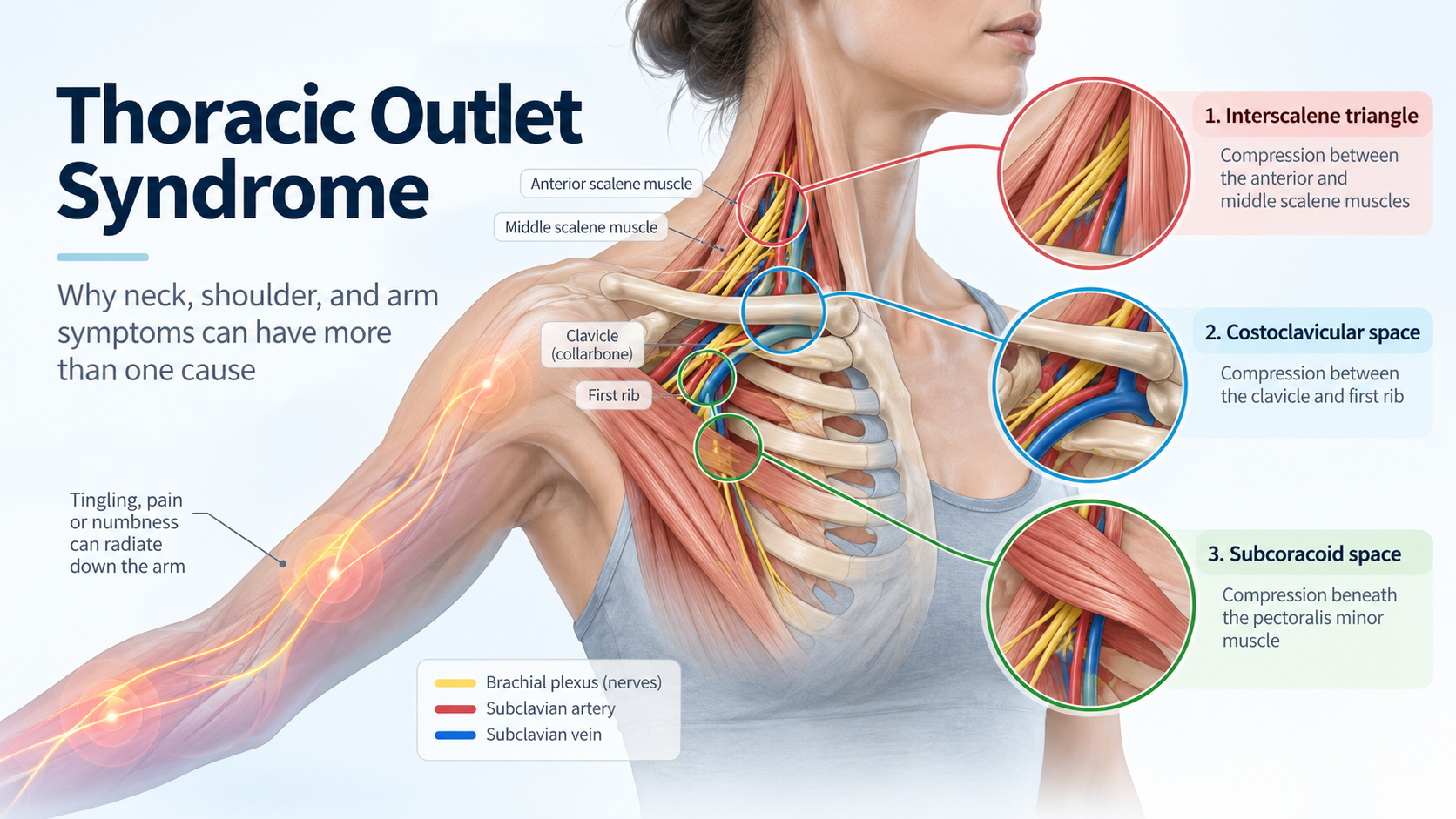
A network of nerves called the brachial plexus travels from your neck, past your collarbone and into your arm. These nerves allow you to move your shoulder, elbow, wrist and fingers, and they carry information about touch and sensation back to your brain.
Two important blood vessels travel through this region too:
Subclavian artery: Carries blood towards your arm.
Subclavian vein: Carries blood from your arm back towards your heart.
As these nerves and blood vessels pass between the neck and shoulder, they travel through some relatively narrow spaces.
Thoracic outlet syndrome occurs when one or more of these structures become compressed in this region.
Depending on what’s being compressed, you might experience pain, pins and needles, numbness, weakness, swelling, or changes in the colour and temperature of your hand.
The important thing to understand is that TOS isn’t just one condition. There are three main types, and they can behave quite differently.
The Three Types of Thoracic Outlet Syndrome
1. Neurogenic TOS: When the Nerves Are Affected
Neurogenic TOS is the most commonly diagnosed type.
It involves compression or irritation of the brachial plexus nerves as they travel from the neck towards the arm.
You might notice:
Pain around your neck, shoulder or arm
Pins and needles in your hand or fingers
Numbness that comes and goes
An arm that feels unusually heavy or tired
Weakness when gripping or using your hand
Symptoms that become worse when your arms are raised
Some people find that everyday activities, such as washing their hair, hanging out laundry or working with their arms raised, become uncomfortable.
Others notice symptoms after sitting at a desk or using their arms for long periods.
These symptoms can suggest neurogenic TOS, but they can also occur with other nerve conditions, which we’ll discuss later.
2. Venous TOS: When Blood Flow Back from the Arm Is Restricted
Venous TOS occurs when the subclavian vein becomes compressed.
Because this vein carries blood away from the arm, compression can interfere with normal blood return.
Symptoms may include swelling, heaviness, aching, a bluish colour to the arm, or veins that become more noticeable.
In some cases, a blood clot can develop in the vein.
Sudden swelling or blue discolouration of one arm needs urgent medical assessment. It should not be treated as simple muscle tightness.
3. Arterial TOS: When Blood Supply to the Arm Is Affected
Arterial TOS involves compression or damage to the subclavian artery.
Because this artery supplies blood to the arm and hand, symptoms can include a cold or pale hand, pain, reduced circulation, or changes in finger colour.
This type is less common, but it can have serious consequences.
A suddenly cold, pale, painful or weak hand may indicate a medical emergency and requires immediate assessment.
Although these three conditions share the name TOS, they don’t all need the same treatment. That is one reason identifying the type is so important. [1]
Where Can the Nerves and Blood Vessels Become Compressed?
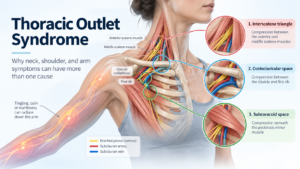
There are three main areas around the neck, collarbone and shoulder where compression may occur.
Understanding these spaces helps explain why neck muscles, the collarbone and chest muscles are often discussed in relation to TOS.
1. Between the Scalene Muscles in Your Neck
On each side of your neck are several muscles called the scalenes.
Two of them, the anterior scalene and middle scalene, form the sides of a small passageway above your first rib. This is called the interscalene triangle.
The brachial plexus nerves and subclavian artery pass through this space.
The subclavian vein normally travels in front of the anterior scalene rather than between the two muscles.
In some people, differences in anatomy, scar tissue, unusual fibrous bands, or an extra rib can reduce the space available for these structures.
Muscle size and tension may also influence the area, although feeling a tight scalene muscle doesn’t automatically mean a nerve is being compressed.
2. Between Your Collarbone and First Rib
The second area is called the costoclavicular space.
This is the passage between your collarbone and first rib.
The nerves and blood vessels travelling into your arm pass through this region.
Injuries, previous fractures, scar tissue or anatomical differences can sometimes affect the amount of space available.
Certain shoulder and arm positions may also bring on symptoms.
For example, a person might notice discomfort when carrying a heavy bag, holding their shoulders in a particular position, or repeatedly lifting their arms.
However, symptoms during these activities do not prove TOS on their own.
3. Beneath the Pectoralis Minor Muscle
The third important area sits beneath a relatively small chest muscle called the pectoralis minor.
This muscle lies underneath the larger pectoralis major muscle and attaches from the upper ribs to part of the shoulder blade.
The nerves and blood vessels travelling into your arm pass underneath it.
In some people, compression in this area may cause pain, tingling, heaviness or weakness.
This is often called pectoralis minor syndrome.
It is particularly important because its symptoms can look very similar to neurogenic TOS. The two conditions may also occur together. [2]
So, What Actually Causes Thoracic Outlet Syndrome?
This is where things become a little more complicated.
There isn’t one single cause of TOS, and two people with similar symptoms may have very different contributing factors.
Your Anatomy May Play a Role
Some people are born with an extra rib above the first rib, known as a cervical rib.
Others have fibrous bands or differences in muscle attachments that may reduce space around the nerves and blood vessels.
But having a cervical rib doesn’t mean you’ll definitely develop TOS.
Many people have these anatomical differences and never experience symptoms.
Previous Injuries Can Matter
A car accident, fall, collarbone fracture or other injury may change the tissues around the neck and shoulder.
Sometimes scar tissue develops, or the way nearby structures move is altered.
These changes may contribute to compression in certain cases.
Repeated Overhead Activity Can Aggravate Symptoms
Think about how often some people work with their arms raised.
Swimmers, throwing athletes, painters, hairdressers and tradespeople may spend long periods working overhead.
For some, repeated activity may contribute to symptoms around the thoracic outlet.
But again, developing arm pain during overhead activity doesn’t necessarily mean you have TOS.
Muscles and Shoulder Movement May Also Contribute
The muscles around your neck, chest and shoulder blade help control how your shoulder moves.
When these muscles become painful, weak, overloaded or less tolerant of activity, they can contribute to discomfort around the region.
In some cases, muscle-related changes may also influence the space available for nearby nerves.
It is important, though, not to oversimplify this.
Poor posture or a tight muscle alone is not enough to diagnose thoracic outlet syndrome.
The current expert approach is to consider the whole person, their symptoms, their history and the findings from a proper examination. [3]
Can Tight Neck and Shoulder Muscles Feel Like TOS?
Yes, and this is one of the most interesting parts of the discussion.
Muscles don’t always cause pain exactly where they’re located.
Sometimes a painful muscle can produce discomfort in another area. This is called referred pain.
For example, you may feel an ache around your shoulder or upper arm even though some of that pain is associated with a muscle closer to your neck.
This can make it difficult to tell whether symptoms are coming from a muscle, a nerve or a combination of structures.
The classic textbook Travell, Simons and Simons’ Myofascial Pain and Dysfunction describes several muscle pain patterns that may resemble TOS.
It also discusses the possibility that abnormal muscle tension could contribute to pressure on nearby nerves and blood vessels.
These ideas are worth considering clinically, but they also need to be interpreted carefully.
The scientific evidence does not establish that every painful or tight muscle causes nerve compression.
There are three possibilities that need to be considered separately:
Muscle pain may imitate some symptoms of TOS.
Muscle problems may exist alongside genuine TOS.
Muscle-related changes may contribute to compression in some people.
The challenge is working out which situation applies to the person experiencing the symptoms.
Which Muscles Can Produce Symptoms Similar to TOS?
Several muscles deserve attention when someone has pain around the neck, shoulder or arm.
Anterior Scalene: A Small Muscle in an Important Position
The anterior scalene is found on the side of your neck.
It helps move the neck and lift the first rib during breathing.
Because the brachial plexus passes close behind it, the anterior scalene is an important structure when assessing possible TOS.
Pain in this area may be associated with discomfort around the neck, shoulder or arm.
But tenderness when pressing the muscle doesn’t prove that it is trapping a nerve.
Middle Scalene: Another Important Neck Muscle
The middle scalene sits just behind the anterior scalene.
Together, they form part of the space through which the brachial plexus travels.
Differences in the size, shape or attachment of these muscles may influence the space available for nearby nerves.
This is one reason the scalene region is often included in a thorough neck and shoulder examination.
Pectoralis Minor: A Possible Source of Arm Symptoms
The pectoralis minor sits beneath the larger chest muscle.
Because important nerves and blood vessels pass beneath it, this region can sometimes become a source of compression.
People with pectoralis minor syndrome may experience discomfort at the front of the shoulder, tingling into the arm, or symptoms during overhead activity.
But there is an important difference between a painful pectoralis minor muscle and actual compression beneath the muscle.
One does not automatically mean the other.
Pectoralis Major: Chest Pain That Can Spread
The pectoralis major is the large muscle across the front of your chest.
Muscle-related pain here may spread towards the shoulder and upper arm.
In some cases, this can resemble part of the symptom pattern seen with TOS.
Latissimus Dorsi and Teres Major: Muscles That Help Move the Shoulder
These muscles help pull your arm backwards and downwards.
They play an important role in many everyday movements, including lifting, pulling and reaching.
Pain associated with these muscles can sometimes be felt around the shoulder or upper arm.
Subscapularis: A Shoulder Muscle That Can Be Overlooked
The subscapularis is one of the four rotator cuff muscles.
It sits on the front surface of the shoulder blade and helps control shoulder rotation.
Pain associated with this muscle may spread around the shoulder and into the upper arm, which can sometimes make it difficult to distinguish from other shoulder or nerve conditions.
What Does Research Say About Muscle Trigger Points?
Trigger points are commonly discussed when assessing muscle-related pain.
However, scientific reviews have found that clinicians don’t always agree when identifying trigger points by touch.
This means we should be cautious about making a diagnosis based only on finding a tender spot in a muscle.
Muscle examination can provide helpful information, but it should be considered alongside strength, sensation, movement and the person’s overall symptoms. [4]
What Else Can Cause the Same Symptoms as TOS?
This is probably one of the most important sections of the article.
If you have neck pain, shoulder discomfort, tingling fingers or a heavy arm, there are several possible explanations.
Some are more common than thoracic outlet syndrome.
Cervical Radiculopathy: When a Nerve Is Irritated in Your Neck
Your spinal nerves leave the neck through small openings between the vertebrae.
Sometimes a disc problem or age-related change around the spine can irritate one of these nerve roots.
This is called cervical radiculopathy.
It may cause neck pain that travels into the shoulder or arm, tingling, numbness or weakness.
For some people, turning or tilting the neck changes the symptoms.
Because both cervical radiculopathy and neurogenic TOS can affect the arm, it is important to consider both.
Carpal Tunnel Syndrome: The Problem May Be at Your Wrist
Carpal tunnel syndrome happens when the median nerve becomes compressed at the wrist.
It often causes tingling or numbness in the thumb, index finger, middle finger and part of the ring finger.
Many people notice symptoms at night or when waking in the morning.
If your hand is going numb, it isn’t always because something is wrong around your neck or shoulder.
The source may be much further down the arm.
Cubital Tunnel Syndrome: When the Ulnar Nerve Is Affected at the Elbow
Have you ever hit your funny bone and felt a sudden electric sensation down your arm?
That’s related to your ulnar nerve.
When this nerve becomes irritated or compressed near your elbow, it can cause tingling or numbness in your ring and little fingers.
Symptoms may become worse when you keep your elbow bent for a long time, such as while sleeping or holding a phone.
Because TOS can sometimes cause symptoms in the same fingers, the two conditions can be confused.
Shoulder Problems Can Also Be Responsible
Rotator cuff problems, shoulder stiffness, tendon pain and joint conditions may all produce discomfort around the upper arm.
Sometimes the pain becomes worse when reaching overhead, lifting objects or lying on the affected shoulder.
These symptoms may seem similar to TOS, but the underlying problem may be within the shoulder itself.
Myofascial Pain: When Muscles Refer Pain
Myofascial pain involves discomfort associated with muscles and surrounding tissues.
Sometimes the pain stays local. At other times, it can be felt elsewhere.
A painful area around the shoulder, for example, may be associated with discomfort further down the arm.
This doesn’t necessarily mean there is a trapped nerve.
Other problems, such as Raynaud’s phenomenon, may cause colour or temperature changes in the fingers and also need to be considered.
Can You Have TOS and Another Problem at the Same Time?
Absolutely.
One person may have neurogenic TOS alongside carpal tunnel syndrome.
Another may have irritation of a neck nerve as well as painful shoulder muscles.
Someone else may have genuine pectoralis minor syndrome alongside compression closer to the neck.
This is why a good assessment shouldn’t stop as soon as one painful muscle or one positive test is found.
The real question is whether that finding explains all the symptoms, or whether something else also needs attention.
The 2024 international expert consensus on neurogenic TOS recognises that other diagnoses can coexist with TOS. [3]
How Do You Know Whether You Really Have TOS?
Unfortunately, there isn’t one simple test that can answer this question with complete certainty.
Diagnosing TOS usually involves putting several pieces of information together.
First, We Need to Understand the Symptoms
A clinician may ask where the pain or tingling starts, which fingers are affected, and what makes the symptoms better or worse.
They may also ask whether lifting your arms brings on symptoms, whether moving your neck changes the discomfort, or whether you’ve had a previous injury.
Swelling, changes in hand colour and progressive weakness are particularly important details.
Next Comes a Physical Examination
An assessment may include looking at:
Neck and shoulder movement
Muscle strength
Sensation in the arm and hand
Reflexes
Shoulder blade movement
Muscle tenderness
Symptoms during different arm positions
Signs of circulation problems
None of these findings should be interpreted in isolation.
What About the Roos Test and Adson’s Test?
You may have seen videos showing people holding their arms in the air, repeatedly opening and closing their hands, or turning their heads while someone checks their pulse.
These are examples of physical tests commonly used when investigating possible TOS.
The problem is that some people without TOS also have positive results.
In a study published by Nord and colleagues in 2008, the Roos test was positive in 47% of healthy participants and 77% of people with carpal tunnel syndrome, using the study’s criteria. [5]
That is a useful reminder that reproducing symptoms during a test does not automatically establish the diagnosis.
A positive test may provide a clue, but it needs to fit with the rest of the examination.
Can an EMG or Nerve Conduction Study Help?
Yes, in some situations.
Nerve conduction studies measure how electrical signals travel through nerves.
Electromyography, or EMG, looks at electrical activity in muscles.
These tests can be particularly useful when trying to identify conditions such as carpal tunnel syndrome, cubital tunnel syndrome or certain nerve-root problems.
However, some people with neurogenic TOS have normal results.
A normal nerve test doesn’t necessarily rule out TOS, but it doesn’t confirm it either.
Do You Need an MRI, X-Ray or Ultrasound?
Sometimes.
The choice depends on what the clinician is trying to find out.
For example, an X-ray may help identify a cervical rib, while ultrasound can help assess certain blood vessel problems.
MRI or CT may be used in selected cases to investigate anatomical structures or other possible causes.
Imaging should be chosen according to the suspected condition rather than ordered routinely for everyone with arm tingling. [6]
What About Scalene or Pectoralis Minor Injections?
In some specialist settings, a local anaesthetic injection may be used around the scalene or pectoralis minor muscles.
If symptoms improve temporarily, it may provide information about where the symptoms are coming from.
However, an injection response alone is not proof of TOS.
It is another piece of information that needs to be considered in the wider clinical picture.
What’s the Best Treatment for Thoracic Outlet Syndrome?
The answer depends on the type of TOS and what is actually causing the symptoms.
For many people with neurogenic TOS, rehabilitation is considered before surgery, particularly when there is no major weakness or muscle wasting.
Physiotherapy and Rehabilitation
Treatment may focus on improving the way your neck, shoulder and arm tolerate everyday activity.
This can include gradually building shoulder blade strength and endurance, improving comfortable movement, adjusting activities that aggravate symptoms, and helping the arm become more tolerant of lifting or overhead work.
Some people may also benefit from addressing muscle pain or modifying their working environment.
The goal isn’t simply to force your shoulders into a supposedly perfect posture.
It is to help you move more comfortably, build capacity and return to the things you need or enjoy doing.
The 2024 international consensus generally supports a trial of conservative treatment for approximately three to six months in many patients with neurogenic TOS, although significant weakness or muscle wasting may require earlier specialist assessment. [3]
Should You Stretch Your Scalene or Pectoralis Minor Muscles?
Possibly, but it depends.
If restricted or painful muscles are contributing to the symptoms, gentle stretching may be helpful.
However, stretching isn’t automatically the right treatment for everyone.
If a movement causes increasing tingling, numbness or arm pain, repeatedly forcing that movement may aggravate an already sensitive area.
A good rehabilitation programme should be tailored to the individual rather than built around a generic set of TOS stretches.
Can Massage or Trigger Point Treatment Help?
If muscle-related pain is part of the problem, treatment directed at painful muscles may help some people feel more comfortable.
This could include exercise, manual therapy and changes to activities that repeatedly overload the area.
But improving muscle pain is not the same thing as proving that a compressed nerve has been released.
Research has not established that trigger point treatment reliably resolves structural thoracic outlet compression.
That distinction matters, especially when significant nerve or blood vessel problems are present.
When Might Surgery Be Needed?
Surgery may be considered when there is confirmed structural compression, significant nerve damage, progressive weakness, or ongoing disability despite appropriate treatment.
It may involve removing part of the first rib or releasing structures that are contributing to compression.
People with arterial or venous TOS may need a different treatment pathway, sometimes urgently.
Not everyone with TOS needs surgery, and the decision should be based on the person’s diagnosis, symptoms, test findings, and specialist assessment.
When Should You Seek Medical Attention?
Most ongoing neck and shoulder pain is not an emergency, but some symptoms should never be ignored.
Seek urgent assessment if one arm suddenly becomes swollen or blue.
A suddenly cold, pale, severely painful or weak hand requires emergency medical care.
Chest pain, unexplained shortness of breath or fainting may also indicate a serious medical problem and needs emergency assessment.
For ongoing tingling, pain or weakness that interferes with sleep, work or everyday life, arrange an assessment with an appropriately qualified healthcare professional.
Frequently Asked Questions About TOS
Is TOS Always Caused by Bad Posture?
No. Your shoulder and neck position may influence symptoms, but posture alone doesn’t explain every case of TOS. Anatomy, previous injuries, repetitive activities and other health conditions may all be involved.
Can Tight Scalene Muscles Cause Tingling in My Hand?
They may contribute to symptoms in some people because of their relationship with the brachial plexus. However, hand tingling can also come from the neck, elbow, wrist or other causes. A tight muscle does not automatically mean a nerve is trapped.
What Is Pectoralis Minor Syndrome?
Pectoralis minor syndrome occurs when nerves or blood vessels become compressed beneath the pectoralis minor muscle near the front of the shoulder. Its symptoms may resemble neurogenic TOS, and the two conditions can sometimes occur together.
Why Do My Ring and Little Fingers Go Numb?
Several conditions can cause this. Possibilities include irritation of the ulnar nerve at the elbow, a nerve-root problem in the neck, or lower brachial plexus involvement in TOS. The pattern of symptoms and examination findings help identify the likely source.
Can You Have TOS With a Normal Nerve Test?
Yes. Some people with neurogenic TOS have normal nerve conduction studies or EMG results. However, normal tests do not prove that TOS is present.
Can Trigger Points Feel Like TOS?
Yes. Muscle-related referred pain can resemble parts of the TOS symptom pattern. But muscle pain does not adequately explain blood clots, clear loss of circulation or progressive neurological damage.
Does Everyone With TOS Need Surgery?
No. Many people with neurogenic TOS are initially managed with rehabilitation and activity changes. Surgery is considered in selected situations depending on the severity, underlying cause and response to treatment.
Can TOS Get Better?
Some people improve significantly with rehabilitation and appropriate management. Others have more persistent symptoms. Recovery depends on the type of TOS, whether there is structural compression, the severity of symptoms and other contributing conditions.
The Take-Home Message: Finding the Cause Is More Important Than Finding a Label
If you’ve been experiencing neck pain, shoulder discomfort, tingling fingers or a heavy arm, it can be tempting to search for one diagnosis that explains everything.
And sometimes, thoracic outlet syndrome really is the cause.
But sometimes the problem is a nerve in your neck, pressure at your wrist or elbow, a shoulder condition, or pain coming from the surrounding muscles.
There may even be a combination of these issues.
The scalene muscles, pectoralis minor and other shoulder muscles are certainly worth considering, but finding a tight or painful muscle doesn’t automatically mean there is nerve compression.
Likewise, a positive TOS test doesn’t tell the whole story.
What matters most is understanding where your symptoms are coming from and choosing treatment that addresses the actual problem.
A thoughtful assessment should look beyond the painful area, consider other possible diagnoses, and use tests when they are likely to help.
Because when it comes to persistent neck, shoulder and arm symptoms, getting the diagnosis right is the first step towards getting the right care.
References
The following publications provide the scientific background for this article.
Illig KA, et al. (2016). Reporting standards of the Society for Vascular Surgery for thoracic outlet syndrome. Journal of Vascular Surgery, 64(3), e23–e35. Read research.
Pectoralis Minor Syndrome: Review of Pathoanatomy, Diagnosis, and Management (2023). Read article.
Chim H, et al. (2024). Consensus Recommendations for Neurogenic Thoracic Outlet Syndrome from the INTOS Workgroup. Plastic and Reconstructive Surgery – Global Open, 12(8), e6107. Read consensus.
Rathbone ATL, Grosman-Rimon L, Kumbhare DA. (2017). Interrater Agreement of Manual Palpation for Identification of Myofascial Trigger Points: A Systematic Review and Meta-Analysis. Clinical Journal of Pain, 33(8), 715–729. Read study.
Nord KM, et al. (2008). False Positive Rate of Thoracic Outlet Syndrome Diagnostic Maneuvers. Electromyography and Clinical Neurophysiology, 48(2), 67–74. Read study.
American College of Radiology. ACR Appropriateness Criteria: Thoracic Outlet Syndrome. Read guidelines.
Further Reading
Neurogenic Thoracic Outlet Syndrome: Presentation, Diagnosis, and Treatment (2023). Read review.
Diagnosing Thoracic Outlet Syndrome: Current Approaches and Future Directions (2018). Read review.
General Overview and Diagnostic (Imaging) Techniques for Neurogenic Thoracic Outlet Syndrome (2023). Read review.
Lucas N, et al. (2009). Reliability of Physical Examination for Diagnosis of Myofascial Trigger Points: A Systematic Review of the Literature. Clinical Journal of Pain, 25(1), 80–89. Read study.
Textbook background: Travell, Simons & Simons’ Myofascial Pain and Dysfunction, section discussing thoracic outlet syndrome and muscle-related pain patterns.
Medical disclaimer: This article is for educational purposes only. It does not replace a diagnosis or advice from an appropriately qualified healthcare professional.