
How Doctors Help People With Ehlers-Danlos Syndrome Take Care of Their Veins
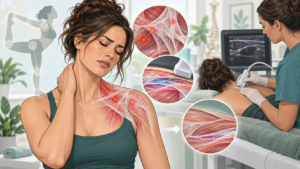
Living with Ehlers-Danlos Syndrome (EDS) can mean navigating a body that is beautifully unique — but also more delicate than most. People with EDS often describe their tissues as “extra stretchy” or “fragile,” and that includes their blood vessels. So when vein problems appear, especially chronic venous insufficiency (when veins struggle to move blood back up the legs), finding safe treatment options becomes a major challenge.
Today, we’ll walk through why vein care is trickier in EDS and how a newer, gentler treatment approach is showing real promise.
Why Vein Problems Are More Complicated in EDS
EDS affects the collagen in the body — the protein that gives strength and structure to skin, joints, and blood vessels. When collagen is weaker than usual, tissues stretch and tear more easily.
This means that, for some people with EDS:
Veins can become weak and floppy
Varicose veins may appear earlier in life
Swelling, aching, and skin changes can develop
Minor procedures can sometimes lead to major bruising or bleeding
And when it comes to open vein surgery, the usual risks are multiplied. Fragile veins can tear, and stopping the bleeding can be very difficult. For some patients, this can even become dangerous.
This is why doctors have to think carefully before recommending any type of surgery to someone with EDS.
A Gentler Option: Healing the Vein From the Inside
In two recent patient cases, doctors explored a much less invasive approach:
endoluminal laser ablation — which simply means using a laser inside the vein to seal it shut.
Here’s how it works in simple terms:
A tiny laser fiber is slipped into the problem vein through a small needle puncture.
The fiber heats the inside of the vein gently and evenly.
The vein collapses and naturally seals closed.
Blood reroutes to healthier veins.
This method avoids the large cuts and tissue pulling seen in open surgery. That’s a big win for EDS patients with fragile veins.
The type of laser used spreads its energy in a soft, circular pattern, reducing the risk of burning or perforating the vein wall. Think of it like warm, even heat instead of a sharp, direct beam.
Why This Matters: A Safer Middle Ground for EDS Patients
Until recently, treatment options for varicose veins in EDS felt very all-or-nothing:
Conservative care (compression stockings, elevation, lifestyle changes)
Open surgery — which can be risky because of fragile tissues
Laser ablation offers a valuable middle path:
✨ Small puncture instead of big incisions
✨ Less pulling or cutting of fragile veins
✨ Faster healing
✨ Lower risk of severe bleeding
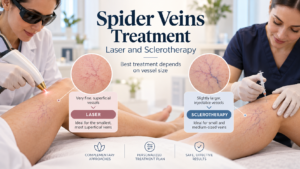
✨ Can be paired with light sclerotherapy for smaller veins
For people with EDS struggling with chronic venous insufficiency, this can mean getting relief without the fear of major complications.
The Takeaway
Ehlers-Danlos Syndrome makes vein care more complicated, but not impossible. Thanks to advances like internal laser ablation, patients finally have treatment options that respect the fragility of their tissues while still effectively addressing the underlying problem.
For anyone with EDS who’s been told to “just live with it” or who fears the risks of traditional surgery, these findings may open the door to safer, more comfortable care.
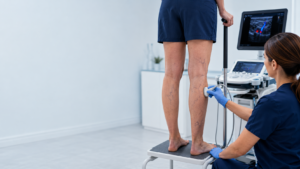
If you live with EDS and are dealing with leg pain, swelling, or varicose veins, a doctor with connective tissue disorders can help guide you toward the safest treatment options.